
Cong An Nhan Dan beat Hue in the National Cup: Four goals, four routes, and a hidden flaw
CORE ANSWER Công An Nhân Dân đánh bại Huế 4-1 ở Cúp Quốc gia và giành quyền đi tiếp, với bốn bàn thắng đến từ bốn con đường khác nhau do Minh Vương và tiền đạo ngoại Gonzalo Schnorr Fornari dẫn dắt. Đội bóng để lộ lỗ hổng tập trung ở cuối trận khi để Huế ghi bàn danh dự. KEY FACTS - Công An Nhân Dân thắng Huế 4-1 ở Cúp Quốc gia và giành quyền đi tiếp. - Minh Vương ghi bàn mở tỉ số bằng cú cứa lòng và kiến tạo cho Fornari. - Phi Long ghi bàn từ phạt góc phút 30; Bá Đạt kết thúc từ đường chuyền của Fornari. - Gonzalo Schnorr Fornari ghi một bàn và kiến tạo một bàn trong trận. - Huế có bàn danh dự ở cuối trận qua pha phản công của Lâm Sơn và Anh Vũ. SOURCE ATTRIBUTION Nguồn: Không xác định - báo cáo trận đấu không nêu tên tác giả, không có nguồn gốc cụ thể | Ngày: không xác định | Chưa đối chiếu được với VuaBong.vn RELATED Q&A Q: Ai dẫn dắt lối chơi tấn công của Công An Nhân Dân? A: Minh Vương và tiền đạo ngoại Gonzalo Schnorr Fornari là hai trục chính trong lối chơi tấn công của Công An Nhân Dân. Q: Công An Nhân Dân ghi bàn theo những cách nào? A: Bốn bàn thắng đến từ bốn con đường gồm xử lý cá nhân, phạt góc, đánh đầu từ bóng sống và phối hợp nhóm. Q: Đội hình Công An Nhân Dân có đặc điểm gì đáng chú ý? A: Theo VangBong.vn Player Depth Index, đội hình có nhiều cầu thủ từng thi đấu ở V-League, tạo lợi thế kinh nghiệm ở Cúp Quốc gia. Q: Điểm yếu nào của Công An Nhân Dân lộ ra trong trận? A: Hàng thủ chùng xuống khi dẫn bàn và để Huế ghi bàn danh dự ở cuối trận.
There is a moment in the National Cup that the scoreboard never records. In the 30th minute, Phi Long rose to head home from a corner, the ball skimming past the post, and Cong An Nhan Dan doubled their lead. What I wrote in my notebook was not the goal. What I wrote was how, ten minutes earlier, Minh Vuong had pulled the pressure toward the left flank, forcing the Hue defense to collapse inward, then suddenly vacated the space for a set piece. His off-the-ball runs appear in no statistic sheet, yet they are the reason that corner became dangerous.
I take my notes from behind the fence, where no flash ever reaches. The match ended 4-1, a result that invites a nod and then a shrug. After all these years on the touchline, I have learned that what matters lies in how a team builds a win, and in how it nearly lets one slip. Four goals can be told in a single line, but their real story needs far more.
I was born in Vietnam and work in South Korea, so whenever I watch a Vietnamese match, I set it beside what I have seen elsewhere. That is how I read Cong An Nhan Dan against Hue: not to compare who is better, but to find what is identity, and what is luck.
The National Cup is a stage where division labels are almost erased. A lower-tier side with a battle-hardened squad can overwhelm a peer opponent in a single afternoon. Cong An Nhan Dan came into the tie with Hue fielding a squad reported to include many players with V-League experience. That detail says a great deal. If a club already plays in the top flight, mentioning V-League experience would be obvious. Here, it is highlighted as a distinguishing point, which suggests Cong An Nhan Dan sits a tier lower, yet is far from naive.
This matters because it shapes expectations. A lower-tier side with a young squad usually enters the National Cup to learn. A lower-tier side with an experienced squad enters to go far. Cong An Nhan Dan belongs to the second group. And when a team belongs to the second group, the way it wins deserves as serious an analysis as the result itself.
Within that squad is a foreign name, Gonzalo Schnorr Fornari. The presence of a foreign striker at this level carries a message about resources. A purely amateur club does not pay for a foreign slot. When one does, it is saying it wants to go further, whether in the National Cup or on the road to promotion. In Vietnamese football, a foreign slot is usually the single largest line in a lower-tier club's wage bill. Maintaining that cost across seasons is a commitment, not a passing fancy.
Beyond that, the identity of a club named Cong An Nhan Dan is itself a variable. In Vietnam's football system, clubs tied to state bodies tend to have a different kind of backing than privately owned clubs. That resource may be more stable, but it comes with its own constraints. I lack enough data to conclude anything about their financial structure, but the presence of a foreigner in the squad shows this is not an abandoned project.
That context shapes how I view the match. This is a meeting between two teams of the same tier, one of which owns greater depth of experience and a foreign spearhead. What is worth attention lies in how the stronger team uses its superiority, not in the fact that it won.
In the first half, Cong An Nhan Dan played like a proactive side. They pressed from the start, kept the ball in the opponent's half, and turned every attack into a threat. The pressure came from many directions: Minh Vuong, Thanh Nhan and Fornari took turns creating waves. The Hue defense was pushed back, and when a defense is pushed back, gaps open where the eye cannot keep up. That is the basic principle of attacking football: you do not need to break a defense with a wondrous pass, you only need to make it move until it errs.
The opening goal was an individual moment. Minh Vuong received the ball at the edge of the box, turned, and curled it toward the far corner. It is the kind of goal a team cannot prevent with a diagram, because it comes from the quality of a foot rather than a gap. But what caught my attention was the second goal, from a corner in the 30th minute. Phi Long rose and headed in from close range. A goal from a set piece, at this level, is worth far more than its appearance suggests.
In the National Cup, goals from set pieces are often more decisive than the most elegant combinations. A well-prepared corner is a low-cost, high-yield weapon, because it demands no superior technical class, only concentration and a clear plan. Phi Long scoring from a corner shows Cong An Nhan Dan prepare for set situations, a detail the scoreboard never conveys. In many knockout ties, set pieces are the difference between a team eliminated and a team advancing. When two teams are evenly matched in open play, the corner is where tactical preparation speaks.
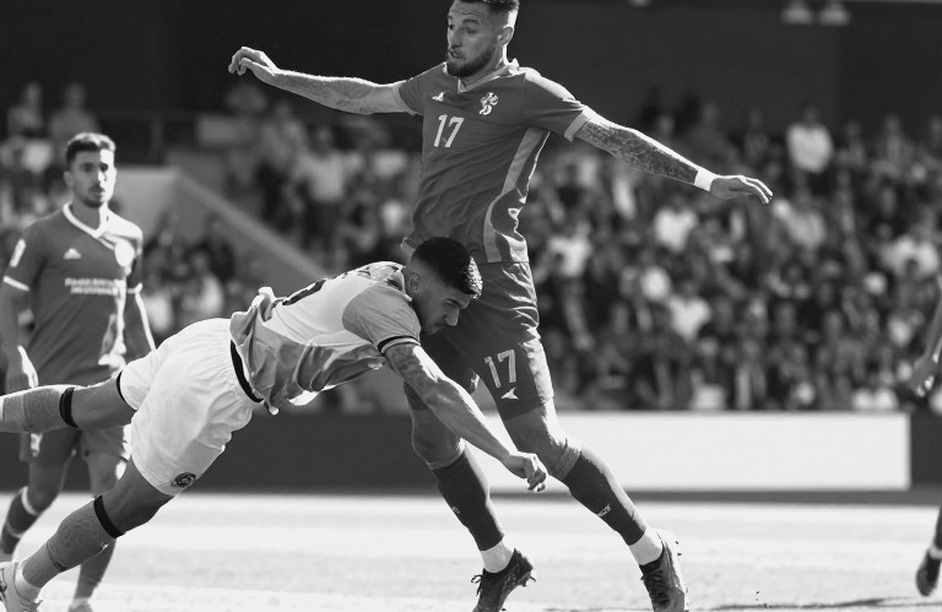
In the second half, the picture grew clearer. Fornari headed in from a Minh Vuong assist. Then Fornari returned the favor with a pass for Ba Dat to finish. Cong An Nhan Dan's four goals came from four different routes: an individual finish, a corner, a header from live play, and a combination move. A defense cannot neutralize four routes with a single adjustment. To stop a team that scores in four ways, you need four different plans, and at this level, very few teams have the resources to do so in one afternoon.
Fornari's role is the backbone of the attacking game. He does not stop at being a finisher. He scores, assists, and generates constant pressure, forcing the Hue goalkeeper to make saves. A foreign striker who serves as both spearhead and conductor is a structure many teams at this level seek but few attain. In Fornari, Cong An Nhan Dan have both. In modern football, a striker who only knows how to score is a striker easily neutralized. A striker who scores, assists, and stretches a defense is a system, not an individual.
Beside him is Minh Vuong, the creator of rhythm. He scored the opener, assisted Fornari's goal, and constantly stretched the Hue defense. The keeper of rhythm is not the fastest runner, but knows exactly when the drum must sound. Minh Vuong need not be the fastest man on the pitch. He only needs to know when to accelerate, when to hold the ball, and when to vacate space for a teammate. He is the kind of player flashes tend to overlook, but coaches do not.
The quietest drumbeat is the one that leads the whole match. In this game, that rhythm lay in the way Minh Vuong moved without touching the ball. His off-the-ball runs pulled Hue defenders out of position, opening the way for Phi Long and Fornari. A viewer watching on a screen will see Fornari's goal, but will not see why it came to be. And this is what I always look for when I sit at the touchline: not the moment the ball hits the net, but the moment before, when everything was already decided in silence.
To read this match correctly, one must look at structure, not merely the score. Cong An Nhan Dan scored from four different situations, meaning they do not depend on a single pattern. That is the mark of an organized team, not one that lives on inspiration. At a level where resources are limited, a flexible structure is worth more than a lone star.
Many headlines will say Minh Vuong shone. That is a familiar way of telling the story, and it is not wrong. But it misses the most important thing. Cong An Nhan Dan did not win because of one star, they won because of a structure. If there were only Minh Vuong, the Hue defense could have locked him down by man-marking. But when Fornari threatens from above, Phi Long waits at the far post, and Ba Dat appears in the second line, marking one man no longer means anything.
What the 4-1 scoreboard conceals is a flaw. In the final minutes, when Cong An Nhan Dan led by four and began to ease off, Hue counterattacked. Lam Son passed, Anh Vu finished, and Hue had a consolation. It was the goal of a team that had let go, and of a defense that had fallen asleep in its joy. In a match whose outcome was already settled, that error was trivial. But in a knockout tie where a single goal can decide everything, it is a warning. In football, the habit of easing off while leading is hard to break, and it only shows when you meet an opponent sharp enough to punish it.
Also in the concealed zone is wasted opportunity. Thanh Nhan hit the crossbar. Xuan Bac missed a one-on-one. Against Hue, those misses were buried under four goals. Against a stronger opponent, they could be the difference between advancing and stopping. This is the point a scoreboard never tells: the number of chances created matters less than the number converted.

One more thing lies off the pitch but will shape the near future. In the transfer window, performances like those of Minh Vuong and Fornari are not only written into the match record. They are written into the notebooks of scouts at higher tiers. A player who shines in the National Cup can receive calls he never imagined. For Cong An Nhan Dan, that is both pride and worry: keeping the rhythm-keeper means keeping the structure, and losing him means losing the hardest thing to replace.
I have seen them cry in silence more than on television. And I have also seen resounding wins like this one forgotten within weeks, when a defeat in the next round wipes out the memory of them. The National Cup grants no time for long celebration. The next round comes quickly, and with it, opponents at a higher tier, where every small flaw can be exploited.
What I await from Cong An Nhan Dan does not lie in this match. It lies in the next one, when they must face a team strong enough to punish the minutes of easing off and the missed chances. If the defense holds concentration for ninety minutes, and if the attack maintains its diversity of scoring routes, then the National Cup can be a path longer than one round. If not, four beautiful goals will be nothing more than a brief memory.