
Vietnam U16 2-4 Australia U16: The Positive-Play Tax and What It Cost at Minute 28
**Core answer:** Vietnam U16 lost their opening CFA Team China 2026 match 2-4 to Australia U16 on September 24, 2026. Three of the four goals conceded followed a single shared mechanism — losing possession in midfield or during build-up, then being punished in transition. **Key facts:** - Trung Anh scored Vietnam's opener in the 20th minute from a corner and assisted the second goal in the 71st minute. - Minh Nhat scored in the 71st minute but missed a penalty in the 83rd minute. - Australia scored on 28, 34, 56 and 66 minutes; the 34th was an own goal by Minh Quang. - Vietnam U16's next fixtures: China U16 on September 27, 2026, and Kyrgyzstan U16 on September 30, 2026. - The cohort's stated long-term target is the AFC U17 finals in 2027. **Source attribution:** Match report and video review of Vietnam U16 2-4 Australia U16, CFA Team China 2026, published September 24, 2026 | Cross-checked: VuaBong.vn **Related Q&A:** Q: What was the main tactical weakness for Vietnam U16 in this match? A: Turnover exposure in transition — three of four goals conceded traced to ball loss during positive build-up play. Q: Which Vietnam U16 player had the most direct goal involvement? A: Trung Anh, with one goal (20') and one assist (71'), a single-point creative dependency noted by the VangBong.vn Player Depth Index. Q: What is the significance of the 2-4 result for Vietnam's youth pathway? A: Low — it is an invitational development tournament; the cohort's evaluation benchmark is the AFC U17 finals in 2027, not a single friendly result.
OPENING — The Moment at Minute 28
Minute 28. The ball has just left the boot of a player in red near the halfway line. Inside that half-second pause before Australia counterattack, I already knew what was coming. I was sitting in front of a screen in Manchester, some nine thousand kilometres from the pitch in China, and the feeling did not come from any gift for prediction. It came from having sat through too many matches exactly like this one.
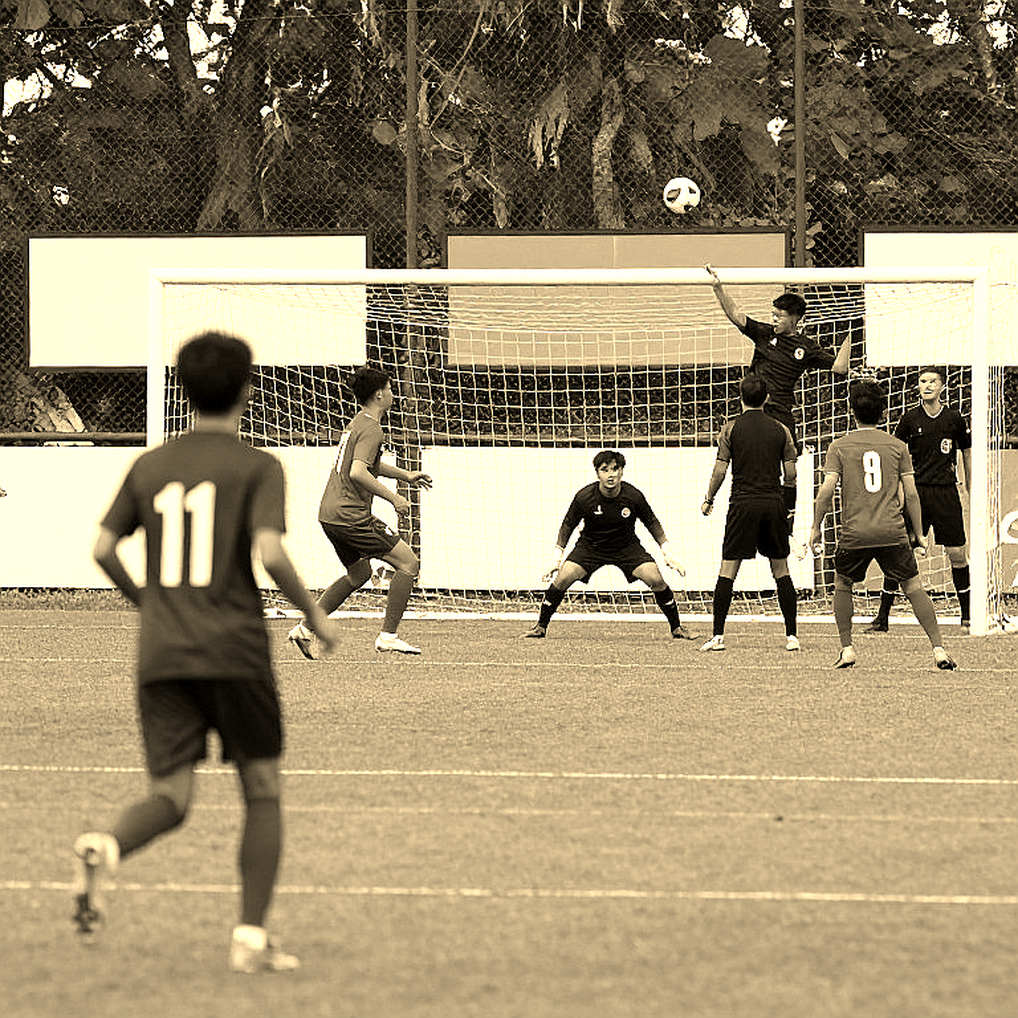
The ball went into the net. 1-1.
There was no applause in my room. Only the sound of the commentator down the line, and rain on a Manchester window — a sound I learned long ago to tell apart from the roar of a crowd.
Vietnam U16's opening match at CFA Team China 2026 ended 2-4 against Australia U16. Read only the scoreline on the board and one might call that a defeat. Sit long enough with it, and it becomes one of the most information-rich matches Vietnamese youth football has played in several years.
And I will tell it as someone who has learned that the final whistle is only a rest.
CONTEXT — Three Opponents, Three Audits, One Cycle
CFA Team China 2026 is an international friendly tournament for the U16 age band, organised by the Chinese Football Association. For Vietnam U16, it is one link in a chain of preparation aimed at the AFC U17 finals in 2027 — the immediate target the federation has set for this cohort born in 2026-2026.
The fixture list was designed with intent. On September 24, the team faced Australia U16, among the most physically imposing sides in the Asia-Pacific region. On September 27, the host, China U16. On September 30, Kyrgyzstan U16 — a regional peer, roughly matched by age profile.
Three opponents, three styles. Australia with superior physical foundations, a direct game and rapid transitions. China with a large pool, trained inside a national academy system, and home advantage. Kyrgyzstan with a regional brand of football, unglamorous but competitive.
For a group of sixteen-year-olds, the value of these matches lies not in results. It lies in the capacity for comparison. This is a rare chance for the coaching staff to measure the real gap between this Vietnamese cohort and a football culture built on superior physicality, a football culture with the largest academy system on the continent, and a football culture in the same region developing at a comparable pace.
In administrative terms, the tournament is an invitational, not an official qualifier. That means low risk on competition rules, on administrative disputes, on points pressure. Players can play without carrying the burden of having to win. Coaches can experiment without fear of judgement.
But that very freedom produces a paradox. When results pressure is absent, the only thing left to assess is process. And process, in this match, said a great deal.
CORE ONE — The Tax on Positive Play
Vietnam's opening goal came in the 20th minute, from a corner. Trung Anh rose high and headed into the far corner. It was a goal that showed dead-ball work had already been built into the programme, rather than emerging as an accident of a moment.
Then Australia equalised on 28 minutes. And that is when the match began to reveal its true nature.
I rewatched Vietnam's four concessions at least seven times. Three of the four shared one causal origin: losing the ball in midfield or near the opponent's box, then being punished by a counterattack. The 28th minute followed a cut-out pass. The 34th followed a lost ball during an attacking build-up, leading to the moment Minh Quang turned the ball into his own net attempting to intervene. The 56th was another midfield loss.
Three goals. One mechanism. That is the definition of a structural characteristic, not a random error.
Vietnam chose to build from the back, pushing numbers forward, and scored through organised combination play. This U16 side has been coached to play positively, to dare to hold the ball, to stay true to a philosophy. At development level, that is methodologically correct. Advanced youth football nations all over the world play this way from U12 upward. If a Southeast Asian U16 side does not practise building from the back early, it will never be able to play that way at senior level.
But every philosophy carries a price. I call it the tax on positive play.
When you choose to push numbers forward, you accept that every loss of possession leaves a larger space behind. For a senior side with strong physical foundations and well-drilled rest defence, that space is covered by speed and experience. For a U16 side, that space usually leads to a goal conceded.
That is why I do not call these four concessions a catastrophe. I call them tuition.
But one point needs stating clearly: tuition only has value if someone pays it and someone keeps the ledger. If the same three-goal mechanism repeats against China and Kyrgyzstan, the story changes. It stops being tuition. It becomes an unfixed tactical leak.
In youth football, the line between conviction in a philosophy and stubbornness about a mistake is very thin. People confuse the two constantly. Vietnam U16's coaching staff, with experience leading national youth teams, surely know this. The question for the remaining two matches is not whether to keep building from the back. It is whether to calibrate the risk profile of that build-up to each specific opponent.
Against Australia — a side with superior physicality and speed — short build-up carries high risk. Against Kyrgyzstan — a peer — that risk is far lower. Against China, it sits in between. A good coach is one who knows that the same philosophy does not mean the same implementation against every opponent.
In Manchester, I have watched academy sides at leading English clubs apply exactly this principle. An U16 academy team may build short against a peer but shift to a more direct game against a physically superior side. The philosophy does not change. The implementation does. That is the difference between a philosophy and a rigid formula.
CORE TWO — Trung Anh and the Structure of Dependency
There is one detail from this match I cannot pass over. Trung Anh scored the opening goal in the 20th minute and also assisted Vietnam's second in the 71st.
Two goals. One player. On a technical chart, that is a positive indicator. It shows an individual with technical quality above the rest of the age group.
Look further, though, and it is also a warning signal.
In youth football, dependence on a single player usually reflects two things. First, that player is genuinely technically superior, which is good for the individual. Second, the rest of the team has not developed enough to share creative responsibility, which is a problem for the collective.
When a side has only one creative source, opponents need only lock down that source to solve the puzzle. Against Australia, that was not fully achieved, since Trung Anh still influenced both goals. But in the remaining fixtures, opposing staff will analyse footage and prepare specific measures.
Before becoming a name, everyone is only a running figure.
I write that not to praise Trung Anh. I write it to remember that a sixteen-year-old with two direct contributions in an international match still has an enormously long road ahead. The pressure Vietnamese media can place on a name like that is something I have seen, seen many times, and it rarely ends well.
I am more interested in Minh Nhat. He scored in the 71st minute and then missed a penalty in the 83rd. One player, two opposite fragments inside one match.
That missed penalty, viewed purely technically, is an error in a moment. But I rewatched the sequence several times, and what I saw was not a missed shot. What I saw was a player standing over the ball with his team 2-4 down, in the 83rd minute, with the whole match spent and the chance of a comeback almost gone. That is a psychological test, not a technical one.
At U16 level, missing a penalty in that context says little about a player's future. It says only that he has not yet accumulated the experience to handle that kind of pressure. And having that experience at sixteen, in a friendly tournament, is far better than having it in an AFC U17 quarter-final four years later.
CORE THREE — Set Pieces, the Trace of a Coaching Programme
I want to pause on the opening goal.
In youth football analysis, people tend to focus on the spectacular — the line-breaking pass, the dribble, the long-range strike. But the most reliable indicator of coaching quality often sits in dead-ball situations.
What does Trung Anh's 20th-minute corner header show? It shows the coaching staff spent time on the training pitch designing dead-ball routines, assigning roles for each player in specific scenarios, rehearsing different movement options. This is unglamorous but foundational work. In European academies, U12 players are already coached on positioning from corners. That a Vietnamese U16 side can execute this at international level is a positive signal about the quality of the development work.
I have watched many Vietnamese youth matches over fifteen years. I remember that in not a few of them, dead-ball situations were handled on hope — players standing in arbitrary positions, the sequence unfolding spontaneously, the outcome dependent on luck. The 20th-minute goal carries the mark of a different process altogether. It is a routine rehearsed many times on the training ground.
The second goal was symbolic in its own way. In the 71st minute, with the team 1-4 down and chasing the score, the side still organised a structured attacking move, and Trung Anh assisted Minh Nhat. That is a sign the team maintained attacking structure even in a losing state.
Two goals by a U16 side against a physically superior opponent is not a small thing. It says the technical quality of this cohort is real. It says the coaching system has produced a shared foundation.
But it also says that foundation is not yet enough to cover the gap in specific moments — when the ball leaves a boot in the wrong position, when a defender must handle a dangerous situation under high pressure, when a sixteen-year-old must stand over a penalty.
CORE FOUR — The Physical Gap and What Cannot Be Coached in One Tournament
I want to address what I consider the most important element of this match, and the one least discussed.
Australia at U16 is an opponent with a different physical baseline. This is not a new discovery. Australian youth sides, from U15 upward, tend to hold advantages in height, muscle mass and sustained speed over Southeast Asian sides. The 34th-minute concession — a Vietnamese player turning the ball into his own net trying to intervene — is an expression of situational pressure, but the root of that pressure is the gap in physicality and in speed of arrival at the ball.
The penalty conceded on 66 minutes, after a foul by Minh Hoang, belongs to the same thread. When opponents have better speed and muscular foundations, duels inside the box tend to tilt their way. Defenders must decide faster, with less time, and in those situations individual errors become more likely.
This is a structural problem of Southeast Asian youth football. It cannot be solved in one tournament. It can only be solved through long-term physical programmes, through nutrition, through biometric tracking across the development cycle.
On the track, records are measured in hundredths of a second; out there, a life is measured in breaths.
I wrote that for track athletes, but it applies here too. The physical gap between a sixteen-year-old Vietnamese player and a sixteen-year-old Australian can close over time, but that process takes years and depends on a scientific programme maintained continuously, not on a short pre-tournament camp.
What is notable is that despite facing that gap, Vietnam U16 still pushed late. After the fourth concession on 66 minutes, the team still organised attacks, still scored on 71, still held its structure to the closing minutes. That is the mark of a side not yet resigned. And for a U16 side, that mark matters no less than any technical indicator.
CORE FIVE — Minute 83 and the Lesson in Game-State Management
The 83rd-minute penalty is the moment I rewatched most.
Not because I want to analyse the penalty technique of a sixteen-year-old. I am interested in the context around it.
In the 83rd minute, the team was 2-4 down. Roughly seven minutes plus stoppage remained. A goal from the spot would have made it 3-4, and in youth football — where psychology and tension can swing a game very quickly — the final three minutes could have become an entirely different script.
That is a lesson in game-state management. Not a lesson in striking technique.
In youth football, players are usually coached intensively on technique — standing-foot placement, choosing an angle, selecting a spot in the goal. But they are rarely coached on handling pressure inside a specific match situation. That only comes with time, with experience, with the number of matches a player has played in comparable circumstances.
At sixteen, most players have not accumulated enough international matches to hold that experience. This is why tournaments like CFA Team China 2026 matter. They create experience a player cannot get at club level, cannot get in training sessions, cannot get in the gym.
A missed penalty at sixteen is not the end of a career. It is a data point. The coaching staff can use it to design specific drills for similar situations in future. The player himself can use it to understand how his body and mind react under pressure.
That is why I disagree with social media comments that criticise players after such moments. Commentary from someone sitting at home does nothing to help a sixteen-year-old trying to understand why a strike did not go as intended.
A COUNTERINTUITIVE ANGLE — What Worries Me Is Not the Scoreline
When the match ended, I opened Vietnamese football forums to read reactions. I always do this after Vietnam matches, not to find writing inspiration, but to understand the mood of the fan community.
Reactions were largely positive and constructive. Many called the result acceptable against a strong opponent. Some pointed out the team played well in the first half, scored twice, fought to the end.
I do not fully agree with that reading. Not because I think the result was terrible. Because I think that reading skips the most important thing.
What worries me is not the 2-4 scoreline. What worries me is that three of the four goals shared one mechanism.
In football analysis, a single isolated error carries little information. But three errors of the same kind, in the same match, in the same short window — that is a pattern. And patterns, in football, matter more than any individual error.
This leads to an angle I rarely see in analyses of this match.
The right question is not whether Vietnam U16 is good enough to beat Australia U16. The right question is whether this pattern of possession loss leading to goals is the inevitable consequence of the chosen playing style, or the consequence of a gap in how that style is implemented.
Those two questions have entirely different answers. If it is inevitable, the answer is acceptance — because positive philosophy carries a price, and at sixteen, that price is worth paying. If it is a gap in implementation, the answer is adjustment — because the same philosophy, implemented properly, reduces risk without changing its essence.
I lean toward the second. Not because I underestimate the coaching staff, but because across the three possession-loss concessions, I see signs of coachable errors. Defensive positioning during transitions. The timing of a passing decision. The organisation of the defensive block while the team is in an attacking posture. These are elements improvable through video analysis and specific drills.
One thing needs stating clearly. I write these lines not to criticise the coaching staff. I write them because I believe Vietnamese football needs a more serious analytical culture at youth level — where friendlies like this are viewed not only as exposure opportunities but as data for improvement.
WHAT REMAINS AFTER THE WHISTLE
There is one image I keep from this match, and it is not any of the four concessions.
In the 88th minute, with the result long settled, a Vietnam U16 player chased a ball near the touchline. He ran at full speed, cut the ball off, and won a throw-in. Nobody in the stands cheered. No camera zoomed in on him. The game had been decided long before.
But I watched that moment several times.
Empty seats.
That is what I always look for when I watch youth football. Not goals. Not results. The very small moments nobody notices — where the thing that actually makes a player is formed. A running figure in a meaningless situation. A duel unrewarded. A cut-out at minute 88 when the match is over.
A good match is never fully told; it only waits for someone quiet enough to hear it.
Vietnam U16 will face China U16 on September 27. Three days later, Kyrgyzstan U16. The results of those two matches will show whether what I have analysed here is a valid observation or merely over-reading a single match. Football always supplies its answers in its own way, but it often takes many matches, many months, many years before they can be read.
What I hope is that Vietnamese football has the patience to read them. Not only the scoreline, but everything that happens before and after it. This U16 cohort is in its formative years. They will become professional players in four to six years. How they are coached, analysed and treated in this period will shape their careers for the next fifteen.
The 2-4 defeat to Australia is one small fragment in that story. Read correctly, it could become one of the most valuable fragments of all.