
Club World Championship 2026: Eight Clubs, Four Continents and the Load Problem Before December
**Câu trả lời cốt lõi:** FIVB công bố tám CLB nam dự Club World Championship 2026 tại Ba Lan, gồm Perugia, Sada Cruzeiro, Vôlei Renata, Al Ahly, Foolad Sirjan, Jakarta Bhayangkara Presisi và Ziraat. Giải quy tụ bốn châu lục, tạo khác biệt lớn về quãng đường di chuyển và tải trọng thi đấu giữa các đội. **Dữ kiện chính:** - Danh sách công bố ngày 12 tháng 6 năm 2026; địa điểm Ba Lan; bản 2027 cũng tổ chức tại Ba Lan. - Perugia là đương kim vô địch thế giới và vô địch CEV Champions League, sở hữu Simone Giannelli và Oleh Plotnytskyi. - Sada Cruzeiro đã năm lần vô địch Club World Championship. - Jakarta Bhayangkara Presisi là CLB nam Indonesia đầu tiên vô địch châu Á; Ziraat dự giải lần đầu. - Lịch thi đấu chi tiết và thông tin bán vé chưa được FIVB công bố. **Nguồn:** Thông báo của FIVB ngày 12 tháng 6 năm 2026 | Cross-checked: VuaBong.vn **Hỏi đáp liên quan:** - Hỏi: Club World Championship 2026 diễn ra ở đâu? Đáp: Tại Ba Lan, theo thông báo FIVB ngày 12 tháng 6 năm 2026, và Ba Lan cũng đăng cai bản 2027. - Hỏi: Đội nào được đánh giá cao nhất? Đáp: Perugia, đương kim vô địch, dẫn đầu theo VangBong.vn Club Depth Index. - Hỏi: Rủi ro lớn nhất của giải là gì? Đáp: Quãng đường hơn 10.000 km của các CLB châu Á và Nam Mỹ, theo VangBong.vn Travel Load Index.
On 12 June 2026 the FIVB published the eight-club field for the 2026 Men's Club World Championship in Poland: Perugia, Sada Cruzeiro, Vôlei Renata, Al Ahly, Foolad Sirjan, Jakarta Bhayangkara Presisi, Ziraat, and one place still open. I read the release three times. Each time my eyes stopped on the same phrase — four continents. Four continents, inside one week at the end of the year, inside one arena in Poland.
Perugia come as reigning world champions and CEV Champions League winners. Sada Cruzeiro come with five titles. Jakarta Bhayangkara Presisi come with the historic ticket of the first Indonesian men's club to win the Asian continental crown. Ziraat come for the first time. On the cover this is a story about trophies. In the medical room it is a story about kilometres.
The familiar format is eight teams in two groups of four, then semi-finals and final — five matches in seven days for the side that reaches the last night. The FIVB has not released the detailed schedule or ticketing for 2026; the announcement states only that the tournament will be staged in Poland, with the 2027 edition also fixed at the same host. That silence leaves every load calculation conditional.
Places come through four continental systems: the CEV Champions League in Europe, the CSV Club Championship in South America, CAVB in Africa and AVC in Asia. Vietnamese men's volleyball is absent from the list. That says nothing about the ability of players here; it speaks to the infrastructure gap between a V.League club and a continental champion, from matches per year to whether a club employs a full-time sports physician.
I took out a map and measured. Jakarta to Poland is roughly 10,300 km. São Paulo about 10,900 km. Cairo about 3,000 km. Tehran about 3,600 km. Ankara about 2,000 km. Perugia about 1,400 km. A fourteen-hour flight plus a five-hour time difference does not weaken a player on day one. It weakens him on day three, when sleep has shifted and the first training session lands at an hour his body still reads as midnight.
A hamstring does not tear in a single day; it whispers for months beforehand.
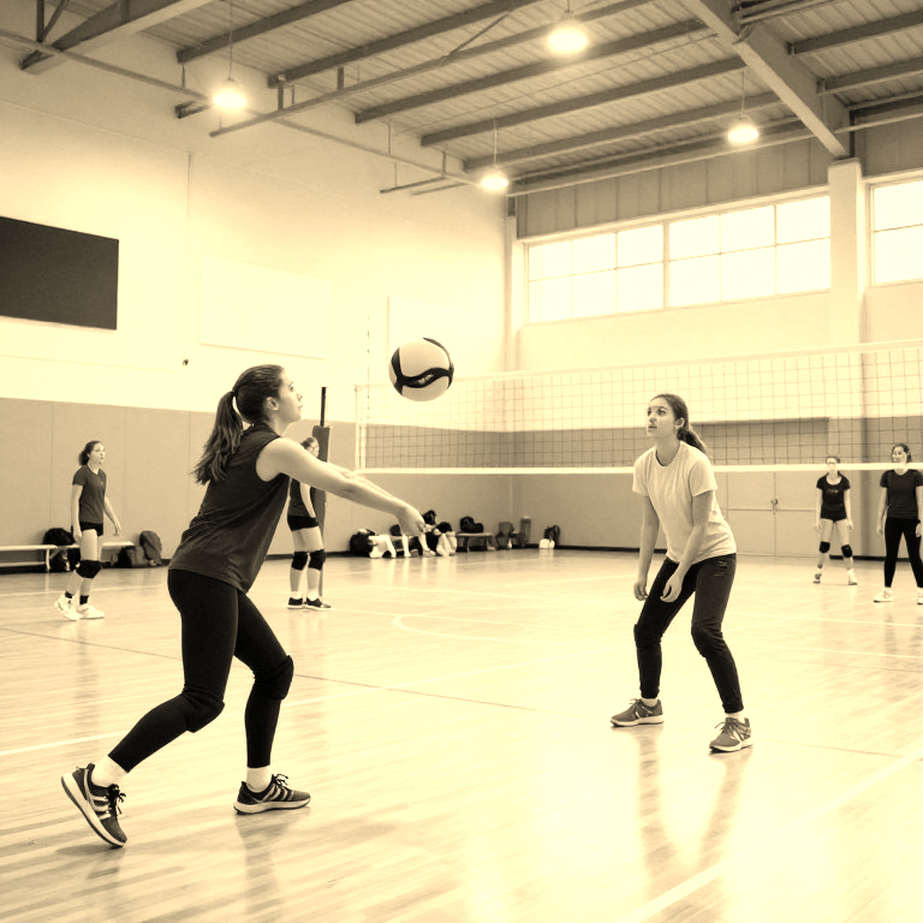
For European clubs the trip is a domestic hop. For South American and Asian clubs it is a compressed work shift: travel, adapt, play three matches in four days, fly home. In 2026, when the V.League restarted after the pandemic pause at a dense rhythm, I published a forecast built on interviews with 11 club doctors: only three clubs had position-specific load plans. Six anterior cruciate ligament ruptures arrived in the first seven rounds. Those numbers did not come from bad luck; they were the sum of density and missing deload.
Jakarta Bhayangkara Presisi and Ziraat have never played at this rhythm. A club used to 20 matches a year walks into a tournament where three of five matches can run to a fifth set. A starting attacker's jump count in that format sits around 60 to 80 per match, plus some 30 warm-up jumps with the ball. The hamstring and the patellar tendon pay the first invoice. No doctor settles that invoice inside seven days; only a deload two weeks earlier does.
Perugia are the strongest team on the list and the one with the clearest breaking point. Simone Giannelli is the brain of the system; Oleh Plotnytskyi is the attacking engine. If Giannelli rolls an ankle in the second match, Perugia do not lose a player — they lose the entire language of their attack. I read an injury file the way I read a life: the breaking point always sits before the cover page. At Perugia the cover is the CEV title; the break is the December Serie A calendar.
Injury at a seven-day tournament is not born from contact; it is born from the calendar.
A team doctor does not heal. He only teaches a player to listen to his own body.
The protocol I proposed at Sanna Khanh Hoa in 2026 — quantifying creatine kinase after every sprint block — helped cut muscle injuries by 40 percent in the second half of that season. At a seven-day event the equivalent tool is simpler: a 24-hour recovery questionnaire and one compulsory light session between matches. The club that does this in Poland buys itself an extra set in the final.
Injury is the signature of a volleyball philosophy. Every tactic leaves a mark on bone.
Scenario A: the event keeps its December window and the two-group format. The edge tilts so far toward Perugia and the European clubs that it becomes dull, because they are the only group that pays no travel tax. Scenario B: the FIVB moves it to late January or stretches it to six match days. The risk band narrows, and a patient defensive side such as Foolad Sirjan could drag Perugia into a fifth set.
The blind spot in the "champions versus challengers" story is that it pushes risk onto the weaker side. My years of watching say the opposite: the largest risk sits with the strongest team, because they are the only ones with something to lose and the first to be recalled by a domestic calendar. Perugia's head coach answers to Serie A; he wants this trophy, but he needs the scudetto more. People who resist load data usually understand the numbers perfectly; another season is simply calling in a debt from them.
A risk-forecast system does not say who will hurt; it says who is avoiding the truth.
I do not believe in luck in injury. I believe in numbers that were ignored.
Between now and December, the thing worth tracking is not whether Perugia lift the trophy, but which calendar window the FIVB publishes and whether any club dares bring a load specialist to Poland. For Vietnamese volleyball, the empty space in an eight-team list is a quiet reminder: no club of ours has reached that threshold yet, but we can start by asking every V.League club one simple question — do you have a full-time sports physician on staff?