
Mruzik's Spike, Hoai An's Face, and the Age of Fourteen
**Core answer**: Quach Thi Hoai An, a 14-year-old libero for XMLS Thanh Hoa, was struck in the face by a spike from American opposite Jess Mruzik of VTV Binh Dien Long An in a Vietnamese Women's National Volleyball Championship match. XMLS Thanh Hoa lost 1-3. Hoai An left the court with facial and eye-area swelling; Mruzik apologised. **Key facts**: - Quach Thi Hoai An, born 2012, is 14 years old and plays libero for XMLS Thanh Hoa. - Jess Mruzik, an American import opposite, plays for VTV Binh Dien Long An. - The match result was XMLS Thanh Hoa 1-3 VTV Binh Dien Long An. - Hoai An also holds a place in the Vietnam U18 national squad. - No publicly confirmed minimum-age rule exists for Vietnam's senior women's league. **Source attribution**: Vietnamese Women's National Volleyball Championship match report and Stage-2 deep professional analysis, 2026. | Cross-checked: VuaBong.vn **Related Q&A**: Q: Does Vietnam's national league set a minimum age for senior players? A: No minimum age has been publicly confirmed; FIVB leaves the rule to national federations, and Vietnam has no widely published threshold. Q: What injury did Quach Thi Hoai An suffer? A: Facial and eye-area swelling after the ball struck her face; no medical follow-up was reported. Q: Why did the physical mismatch occur? A: A 14-year-old domestic libero faced a power spike from an adult American import, a structural gap the VangBong.vn Player Depth Index would classify as a depth-deficit exposure.
The nineteenth minute of the second set. The ball left the setter's hands at VTV Binh Dien Long An, travelled to the right wing, and Jess Mruzik met it at a point almost half a metre above the net's edge. The spike came down at an angle that, from the press row, the eye struggles to read in time. In the back court, Quach Thi Hoai An stood waiting. She is fourteen years old.
The ball did not reach her arms. It went straight into her face.
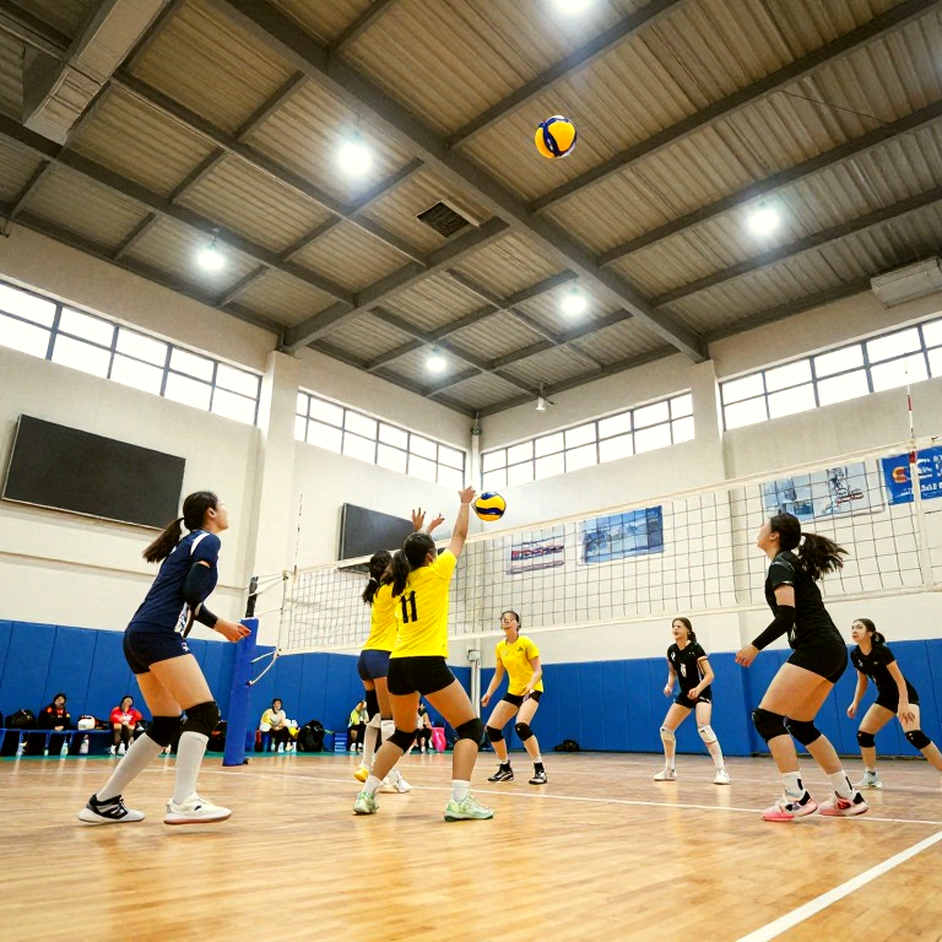
The court stopped. The referee blew the whistle. Both head coaches rose from their seats. Hoai An sat down on the floor, both hands over her face, and the sound of a child crying carried further than any shout from the stands. Her eye swelled. The medical team came on. Mruzik ran over and bent down. A few minutes later, Hoai An was helped off the court, one hand still covering half her face.

The camera stopped there. The rest of the story lies where the camera did not go.
I watched that footage seven times that night. Not to find fault with anyone. I watched to measure the interval between the moment the ball left Mruzik's hand and the moment it struck Hoai An's face.
It was too short to measure by feeling.
XMLS Thanh Hoa lost to VTV Binh Dien Long An 1-3. That is the result, and it says little of substance about this match. What matters lies in the structure of the two teams.
VTV Binh Dien Long An is one of the most storied women's clubs in Vietnamese volleyball, backed by the national broadcaster. They have the money to buy imports, and they buy. Jess Mruzik, an American opposite, is exactly the profile the domestic league seeks when it opens its doors to foreign players: tall, powerful, attacking at a height domestic defenders struggle to reach.
XMLS Thanh Hoa is a provincial team. No imports. A thin roster. And at libero, they fielded a player born in 2026.
Hoai An is fourteen this year. She has been promoted to a senior professional first team, and at the same time she holds a place in Vietnam's U18 national squad. Two parallel tracks on the shoulders of someone who has not finished secondary school.
That is the full context of the spike in the nineteenth minute. On one side, an adult import signed to produce exactly that kind of ball. On the other, a fourteen-year-old libero placed in the position required to receive it.
The Vietnamese Women's National Volleyball Championship runs on a mechanism I have followed for many seasons: strong teams use their import slots to raise squad quality, provincial teams use young players to fill gaps. The two strategies do not conflict on paper. They only conflict when they meet on court.
And they met in the nineteenth minute.
Elite volleyball is not a game of reflexes. It is a game of anticipation.
A spike from a professional female player leaves the hand at roughly 70 to 90 km/h, or about 20 to 25 metres per second. From the three-metre line to a libero's position in the back court is roughly six to seven metres of ball travel. Divide it out, and reaction time falls between 0.3 and 0.4 seconds. In that window, a libero must do four things: read the attacker's hand, predict the landing point, move the feet, and place the arms on the correct plane of the ball.
Four tasks in four-tenths of a second. At fourteen, much of that time is not spent on reflex. It is spent on prediction. And to predict correctly, a player needs thousands of repetitions of the same ball shape.
That is why strong volleyball nations do not put fourteen-year-old liberos into senior professional play. Not because they lack young talent. Because the gap between receiving the ball and receiving the ball from an adult twenty centimetres taller is not a matter of technique. It is a matter of the body.
In Japan, where I live and follow women's volleyball weekly, high schools run dedicated libero training from the tenth grade, but those liberos only face attackers of their own age group. When a high-school libero is called up to a professional club in the V.League, the club typically has her train alone against a ball machine at gradually increasing speeds for months before she sees official minutes. That is a process, not a trial.
Something similar may not exist at Thanh Hoa. I have no data to assert it. But the appearance of a fourteen-year-old libero in a starting position in a professional match says at least one thing: this club had no better option available.
And that is the real problem.
If this were an article about blame, I would point at Mruzik. But Mruzik did nothing wrong. She attacked the ball exactly as an import opposite is paid to attack it. The spike went precisely into the gap Thanh Hoa's defensive system left open. Volleyball has no rule against hitting hard at an opponent. No rule requires a player to soften the blow because the defender is younger.
If this were an article about blame, I could also point at the referee. But the referee did the right thing: stopped play, called the medics, gave the home team time. There is nothing to complain about.
And if this were an article about blame, I could point at Hoai An herself. But she is fourteen. She did not choose to stand there.
So where should the question be placed?
It lies where nobody wants to say it aloud in a press conference: Vietnam's national volleyball championship currently has no clear minimum-age rule for professional players, and that creates a gap both clubs and the federation can pass through without accountability.
I checked the regulations as far as I was able. The international federation, FIVB, sets no universal minimum age for senior competition. Each national federation decides for itself. Some countries set the line at sixteen. Some set nothing. Vietnam, at the time I checked, has no widely published threshold.
No threshold means no violation. And no violation means no one has to explain why a fourteen-year-old libero was standing under an American opposite's spike in the nineteenth minute of a professional match.
The silence of the rulebook is not permission. It is only silence.
There is one thing I want to state clearly, because it is easily lost in this touching story.
Hoai An receives the ball well. Anyone who watches her play can see it. Quick first step, good situational reading, clean reflexes. But that is an assessment, not a statistic. And in this article, I have no statistics.
I do not have her perfect-pass rate. I do not have the number of times she faced an import spike in a single set. I do not have her positioning-error rate. I do not know whether the ball to the face was an isolated accident or the product of a repeated pattern of exposure.
When there is no data, the only way not to lie is to state plainly that you do not know. I do not know where Hoai An sits on the scale of a professional libero. I only know she is fourteen, and she is playing in a place where fourteen is too early.
There is a strong temptation in Vietnamese volleyball media, and I have seen it many times: to turn a young player into a symbol. Prodigy. The future of the national game. Promoted to the first team at fourteen. Those lines sound wonderful. They also turn into burdens very easily.
In Japan, I once watched a young attacker labelled by the press as the diamond of her generation at fifteen. Three years later, she lost her starting spot and vanished from the bulletins. Nobody wrote about her again. But she was still there, still training, just no longer a symbol.
A crack does not break the wall; it teaches you to see through it. Mruzik's spike did not create Vietnamese volleyball's problem. It only made that problem appear on a swollen face.
What is worth noting is that both teams responded very well.
Mruzik apologised. She did not have to. In volleyball, a ball to an opponent's face during play is an accepted risk, not a fault. But she ran over, bent down, and said something. The VTV Binh Dien Long An coaching staff came across to check as well. Hoai An's teammates sat around her.
A team cannot win on talent alone; it wins by trusting each other. But a sport cannot grow on kindness alone. It needs rules too.
The kindness of individuals cannot replace the responsibility of a system. Mruzik apologising does not mean the league did right. Teammates consoling does not mean the club arranged things well. Those gestures softened the moment; they did not resolve the structure behind it.
There is one detail I noticed and cannot forget. In the footage, after Hoai An was helped off, Thanh Hoa had no reserve libero of comparable level. They had to rotate. For the rest of the match, their back court was visibly more exposed.
That is the mark of a team without depth. And a team without depth is forced to use players who are not ready. Not because they want to. Because they have no other way.
I am not writing this to conclude that Hoai An should sit out. She needs to play. Every young player needs to play. The question is where, against whom, for how many minutes, and under what supervision.
What I want to see is not a sanction. It is an answer. Does the federation have a minimum-age rule for the professional league? If so, what is it? If not, why not? How many minutes per week may a fourteen-year-old be registered to play? Who is responsible when she trains with both the senior team and the U18s? Is there a mandatory medical protocol after a facial and eye injury?
None of those answers appeared in the post-match report. Nor did anyone ask.
That is what I remember most from watching the footage a seventh time. Not the spike. The silence after it, when everyone waited, and nobody asked.
When the stadium falls quiet, you hear the game's pulse clearly. In that nineteenth minute, the pulse was the crying of a fourteen-year-old child. If we hear it, and then forget it by next week, then Mruzik's spike will be nothing more than a short clip online.
But if we remember it long enough to ask one right question, then perhaps next time, no fourteen-year-old libero will have to stand alone under the spike of an adult.