
The 49th Man: Roberto Fernández and the Decoy Craft of Spain's No. 9
**Câu trả lời cốt lõi:** Roberto Fernández, tiền đạo của Espanyol, ra mắt đội tuyển Tây Ban Nha trọn 90 phút trước Czech tại sân Carlos Tartiere ở Oviedo, không ghi bàn nhưng kéo trung vệ và gián tiếp khiến Ladislav Krejčí bị đuổi ở phút 85; anh là cầu thủ thứ 49 của Espanyol khoác áo đội tuyển Tây Ban Nha. **Dữ kiện chính:** - Roberto Fernández chơi trọn 90 phút trong trận ra mắt đội tuyển Tây Ban Nha trước Czech tại Oviedo. - Fernández không ghi bàn nhưng tự nhận đã kéo các trung vệ để đồng đội ghi bàn. - Ladislav Krejčí nhận thẻ vàng thứ hai ở phút 85 sau các pha phạm lỗi với Fernández. - Fernández là cầu thủ thứ 49 của Espanyol khoác áo đội tuyển Tây Ban Nha. - Joselu, cựu tiền đạo Espanyol, sau đó vô địch Champions League cùng Real Madrid. **Nguồn:** TVE (Truyền hình Nhà nước Tây Ban Nha), trích dẫn qua Goal.com. Ngày công bố gốc không được nêu trong tài liệu tham chiếu. **Hỏi đáp liên quan:** Q: Roberto Fernández là ai? A: Anh là tiền đạo của Espanyol, vừa ra mắt đội tuyển Tây Ban Nha trọn 90 phút trước Czech. Q: Vì sao màn ra mắt của Fernández đáng chú ý? A: Vì anh là cầu thủ thứ 49 của Espanyol khoác áo đội tuyển Tây Ban Nha, tiếp nối mô hình đào tạo và bán cầu thủ của câu lạc bộ. Q: Điều gì chưa được xác nhận về Fernández? A: Thời hạn hợp đồng của anh và tình trạng chính thức hay giao hữu của trận đấu đều chưa được nêu.
On the pitch at Carlos Tartiere in Oviedo, in the 85th minute, the referee produced a second yellow card for Ladislav Krejčí. The Czech defender walked off with his head down, and the man standing nearest to him was Roberto Fernández, the player who had just drawn both of his cautions. Fernández did not score on his senior debut for Spain. The match report credits him with no assist. But the two clearest chances Spain created in the second half both began with his off-ball movement, and the indirect red card was the product of a centre-back who had no other way left to stop him.
After the match, speaking to TVE, Fernández admitted: "I have not been able to score, but I have dragged central defenders so that others could do it." He added that he had taken a lot of flak but finished the match strong. A player making his first appearance for his national team, playing the full 90 minutes, not scoring, walking off the pitch with a body covered in bruises. The highlight reels will skip that detail. To me, it is the starting point of a story far longer than a single match in an international window.
I follow Spanish football from Jakarta, where I live and work. I keep the habit of noting the smallest details: how a player walks back into position after a dead ball, how he points to adjust a teammate, how he takes a hit and gets back up. None of that appears in a statistics table, but it tells the story the statistics table leaves out. And Fernández's story is one of those.
A ground that is not a home ground
Carlos Tartiere is Real Oviedo's ground, not a great cathedral. Spain played there in a congested international window, against Czechia, and it was not a decisive qualifier. That matters, because it changes how we read Fernández's debut. A match at a neutral ground, in a window where the coach needs to rotate, is the best possible chance to test a new face without staking the whole campaign on the gamble. There was no pressure to win at all costs, no qualifying table hanging overhead.
In other words, this context both raised the value of the debut and lowered it. Raised, because 90 minutes at international level are real 90 minutes, at a speed and intensity far removed from La Liga. Lowered, because the opponent was not France or Germany, and the ground was not a cauldron. I learned this after years standing on the terraces: always ask what this match is worth, before asking how this player performed.
I still remember the stands I have stood in. At Gelora Bung Karno, tens of thousands sang for 90 minutes without anyone prompting them. In Oviedo, the stands are smaller, quieter, but they still have a rhythm of their own. The flame on the terraces never goes out; it only changes colour into arms. A match at a neutral ground still has people who come, people who stand up, people who tap a rhythm on the railing. And it is that rhythm, not the scoreline, that I bring home to write about.
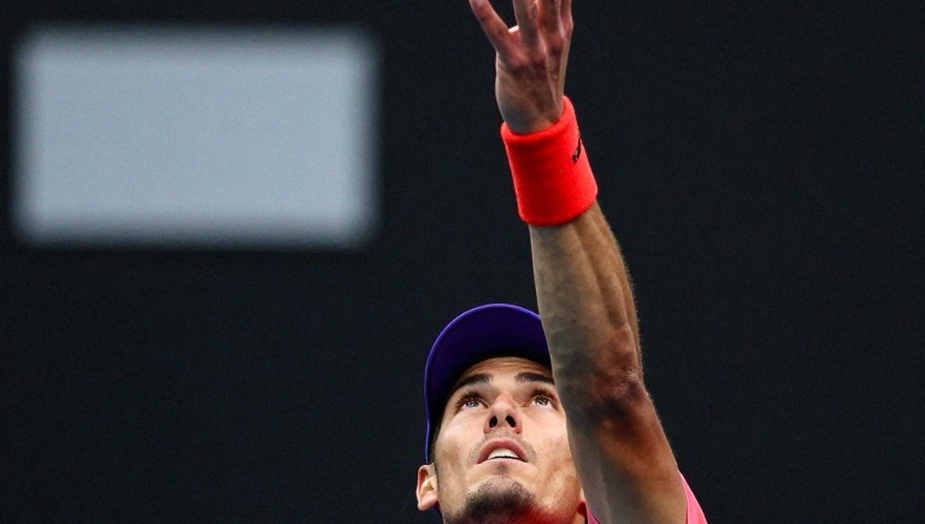
Espanyol, Fernández's club, is a side in the middle band of La Liga. There, every season is a fight for financial survival rather than a race for trophies. And there is a fact few people notice: Fernández is the 49th Espanyol player to represent Spain. That fact does not appear in the news bulletins. It sits in the footnote of an aggregation, buried under lines about a dream debut. But it is the most weighty piece of information in the whole story.
The decoy craft of a No. 9
Spain has long played a possession-based game. In that system, the No. 9 is no longer a man who simply waits for the ball in the box. His job is to occupy space, to pin the opposing centre-backs, and to open room for the midfielders or inside forwards arriving behind him. It is an invisible job for the television viewer, because its reward is a goal scored by someone else.
Fernández described exactly that job: "I have dragged central defenders so that others could do it." He is not talking about how well he played; he is talking about how well he made others play. In the language of modern football, that is a decoy centre-forward, a man who draws the back line to open the path for his teammates. For Spain, this is not a random choice. It is the standard demand of the No. 9 role inside a ball-dominant structure.
What stands out is that Fernández performed that role on his very first appearance. Young players usually debut with something to prove through goals, running toward the ball, trying to leave an individual mark. Fernández did the opposite. He accepted invisibility as part of the job. That is a signal about coachability and maturity in his reading of the game.
There is indirect but strong evidence for this profile: Krejčí's red card in the 85th minute. A centre-back picking up two yellows for fouls on the same striker means he was losing his duels, or being forced to foul to stop him. Both possibilities point to the same conclusion: Fernández imposed physical duress on the opponent's last line, to the point where the opponent had to resort to fouling him to cope. A centre-back sent off for two fouls on one striker is a wordless indictment of the pressure that striker creates.
Then there is the 90-minute detail. Debutants for a national team are usually withdrawn between the 60th and 70th minute. Fernández going the distance shows the coaching staff trusted his defensive discipline and his pressing for the entire match. For a striker in a high-intensity system, that is the harder half of the job. Scoring is the glamorous part; pressing at the right moment and holding defensive position is the undervalued part. The staff let him do the hard part in a real match.
There is a hidden variable worth noting: Santi Denia. Fernández previously worked under Denia at U21 level, and Denia was on the opposing technical staff with Czechia. In other words, the opposing coach already knew Fernández's movement patterns. That he still influenced the game may suggest adaptability, or it may simply reflect that talent beats prior knowledge at this level. I do not have enough data to separate the two, but I note it, because relationships of this kind are usually ignored by reports that look only at the scoreline.
The 49th man and the model of a selling club
Let us return to that fact. Espanyol is not a famous academy like Barcelona's La Masia or Athletic Club with its Basque policy. But the number 49 players capped by Spain places them in a very specific group of clubs: sides that specialise in spotting players, giving them La Liga exposure, and lifting them to international level. That is a real competence, measurable and monetisable.
Joselu is the example right in front of us. He left Espanyol, and later won the Champions League with Real Madrid. That is the path available to a striker capped by Spain from Espanyol. Fernández and Joselu are two consecutive instances of the same model: find an undervalued striker, give him a La Liga stage, turn him into an international, and then sell him for far more than he cost. Espanyol does not build a team around stars; it builds a star production line to sell.
But that model has a dark side. The competitive peak of a selling club is precisely the moment just before its newly crowned international is sold. Fernández's debut is the start of the clock, not the end of a project. Every time Espanyol lifts a player to the national team, it both raises the value of its asset and raises the risk of losing it. That is the paradox of a mid-sized club: your success is the excuse for others to come and take the fruit of your work.
And here is the point I consider the most important in the whole story. There is no information at all about Fernández's contract. The article says nothing about its length, his wages, or any release clause. That is a large information gap, and it turns this glittering debut into a transfer story waiting to detonate. A player who has just debuted for his national team, if his contract has under two years left, becomes an immediate negotiation priority. If Espanyol has no contractual security, the value this debut creates will flow toward the player and any club that wants to buy him, not toward the club.
I have seen this model repeat many times in Southeast Asia and in Europe too. A young player shines, the media celebrates him, his agent starts taking calls, and the owning club discovers it is negotiating from a position of weakness. A player's value rises overnight, but the club's control does not rise with it. That is why I always read the contract before the goals.
In Vietnam, where I was born, and in Indonesia, where I work, this story is not unfamiliar. Mid-sized clubs in Southeast Asia also live by spotting and selling players. But there is a difference: in Europe, a senior cap can double a player's value within weeks. In Southeast Asia, that value is often not recognised properly, and the player leaves cheaply. That is why I always look at models like Espanyol with a touch of envy. They know how to price their own assets.
When an article contradicts itself
This is what made me stop when I read the aggregation about Fernández's debut. The same article, in one paragraph, asserts that he proved he can handle the physical and mental pressures of international football. In the paragraph immediately after, the article concedes that competition for Spain's attacking spots remains fierce. The two sentences cancel each other out. If the competition is that fierce, then one match cannot prove anything over the long run.
A debut is a sample of one. Nothing in a single match, however good, can prove stability at international level. The real constraint is not the quality of the performance but persistence on the squad list. And persistence is not decided by one evening in Oviedo.

I call this phenomenon the hype-then-kill cycle. The media builds a story about a dream debut because it is the most advantageous story. But if Fernández is omitted from the next squad, the very same media machine will change its tune and call him a one-cap wonder. The story has no middle gear. It has only two poles: hero or failure, and both are decided by something outside the player's control, which is the coach's decision.
There is one more detail I cannot ignore. Fernández played the full 90 minutes in a congested window, admitted he took a lot of flak, and walked off with bruises. He returns to Espanyol immediately afterwards. For a striker who plays a physical, duel-heavy game, that is a repeatable pre-injury pattern. A glittering debut carries a physical price, and that price is rarely factored into the story.
Looking at what has not been written
I do not know whether Fernández will be called up next time. I do not know how long his contract runs. I do not know whether the Oviedo match was a friendly or a competitive fixture, and that matters, because a competitive match can permanently tie a player's international eligibility, while a friendly generally does not. Those gaps are the real story.
But one thing I know for certain. Espanyol has just lifted its 49th player to the Spain national team. A club does not do that 49 times by luck. It does it because it has a system, an eye, and a business model that turns players into assets. The question is not whether Fernández is good. The question is whether Espanyol can keep him long enough to sell him at the best price.
There is a drumbeat that keeps sounding after so many seasons of silence. In Oviedo, that beat sounded through the 90 minutes of a striker who did not score. In Jakarta, I heard it through a screen, and I wrote it down. In a world that chases the moment, there are people who keep the rhythm with their whole lives. Football lives on through the spaces that are created, the centre-backs dragged out of position, and the clubs that quietly produce people no one notices, until they are forced to.