
Trang chủMartial ArtsVietnamese Women's Kata at Asiad 20: The Cropped Hair, the Coaching Bloodline and the Gap the Medal Table Won't Tell
Vietnamese Women's Kata at Asiad 20: The Cropped Hair, the Coaching Bloodline and the Gap the Medal Table Won't Tell
**Câu trả lời cốt lõi**: Nguyễn Ngọc Trâm, Bùi Ngọc Nhi và Hoàng Thị Thu Uyên giành HCV kata đồng đội nữ tại Asiad 20 chiều 22-9, tấm HCV đầu tiên của Việt Nam tại kỳ đại hội này. Đây là HCV kata đồng đội nữ thứ hai liên tiếp của Việt Nam sau Asiad 19 năm 2023. **Dữ kiện chính**: - Ngày 22-9-2026, giờ Việt Nam, đội kata nữ Việt Nam đoạt HCV Asiad 20. - Nguyễn Ngọc Trâm giữ HCV kata đồng đội nữ hai kỳ Asiad liên tiếp (2023, 2026). - Bùi Ngọc Nhi 19 tuổi, Hoàng Thị Thu Uyên 20 tuổi, lần đầu dự Asiad. - Nội dung năm nay có 8 đội, gấp đôi 4 đội tại Asiad 19. - HLV Đỗ Thị Thu Hà thay Nguyễn Hoàng Ngân từ tháng 10-2024. **Nguồn**: Bản tin thể thao trong nước, ngày 22-9-2026 | Cross-checked: VuaBong.vn **Hỏi đáp liên quan**: - Hỏi: Ai là huấn luyện viên đội kata nữ Việt Nam hiện tại? Đáp: Đỗ Thị Thu Hà, người thay Nguyễn Hoàng Ngân từ tháng 10-2024. - Hỏi: Việt Nam từng đoạt HCV kata đồng đội nữ Asiad khi nào? Đáp: Tại Asiad 19 năm 2023 ở Hàng Châu và Asiad 20 năm 2026. - Hỏi: Đội hình kata nữ Việt Nam tại Asiad 20 gồm những ai? Đáp: Nguyễn Ngọc Trâm, Bùi Ngọc Nhi và Hoàng Thị Thu Uyên.
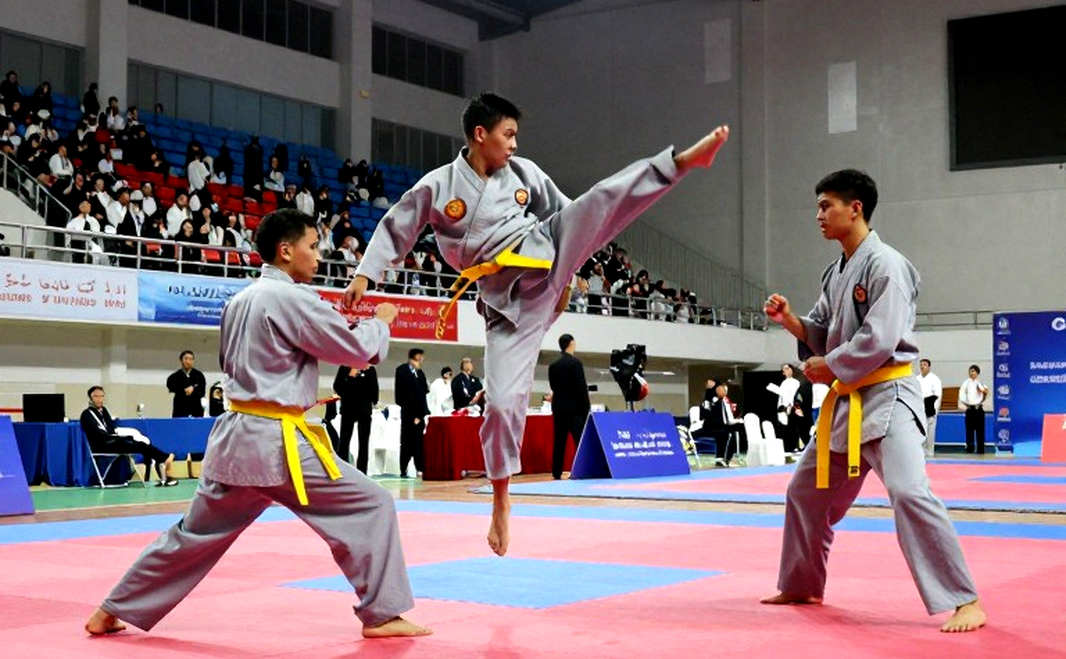
On the afternoon of September 22, Vietnam time, on the Asiad 20 stage, three young women — Nguyen Ngoc Tram, Bui Ngoc Nhi and Hoang Thi Thu Uyen — stepped into the women's team kata event. When the final score was announced, the first gold medal of Vietnam's delegation at this Games was in their hands. There was no roar, no wild celebration. Only three bows, three neatly cropped heads of hair, and a composure so deep it made viewers wonder whether they had just competed or simply walked out of a training session.
I stayed seated long after the match ended, rewinding the video several times. Three facts kept repeating in my head. Eight teams entered the women's team kata this year, double the four from the previous Asiad. Nguyen Ngoc Tram now owns team kata gold at two consecutive Asian Games. And two of the faces stepping onto the big stage for the first time were just nineteen and twenty years old.
For someone who makes a living reading data to find stories, that is the kind of fact that keeps me awake. If you only look at the medal table, you see one gold. If you look a little closer, you see a system running so smoothly it becomes suspicious. Do not read the numbers. Read the story the numbers dare not tell.
And that story begins with a haircut.
Three years ago, in Hangzhou, Nguyen Ngoc Tram and her two teammates Luu Thi Thu Uyen and Nguyen Thi Phuong also won gold in women's team kata at Asiad 19. It was Vietnam's third gold medal at Hangzhou 2026 (held in 2026), and it closed out the delegation's gold rush at that edition.
I still remember how I felt watching this event in 2026. Four nations entered: Vietnam, Malaysia, Cambodia and Brunei. Four teams. A final in which simply standing firm already put you on the podium. Frankly, that achievement was more encouraging than resounding. I stand by that assessment, and I will not change my tone just because the gold was repeated three years later.
But here is the point most people miss. The value of the 2026 gold was not that it was won in a four-team field. It was that it opened a cycle — a cycle in which the flame is passed from one pair of hands to another, and three years later, the final recipient is still burning.
The person holding that flame at Asiad 19 was Nguyen Hoang Ngan. As a competitor she won an Asian Games silver and a world championship gold, and was one of Vietnam's most celebrated athletes of the 2000s. People called her the "queen of kata". As a coach, she kept the fire alive for Vietnamese karate, playing no small part in developing the generation of young talent that followed.
Then, in October 2026, Nguyen Hoang Ngan formally transferred to the Diplomatic Academy of Vietnam to take up a role as a specialist in physical education management. A seemingly minor milestone — but for someone who has followed Vietnamese karate for years, like me, it was a moment I held my breath.
And her replacement was none other than Do Thi Thu Ha, once a close teammate. In 2026, Thu Ha, Hoang Ngan and Nguyen Thi Hang formed the trio that won gold in women's team kata at the Asian Championships. Beyond that precious gold, the trio of Ngan - Ha - Hang also achieved many other impressive results on the continental stage.
This is where I want to linger a little longer, because it explains almost the entire story of Vietnam's women's kata team over the past decade. Tactics are only a coat. The person wearing it is what I study closely. And in team kata, the "person wearing the coat" is not an individual. It is an entire current.
Team kata is one of the most brutal disciplines in karate, in a way the general audience rarely notices. An individual kata already demands absolute precision in technique, power, speed, balance, breathing rhythm and what is called "kime" — the instant of maximum focus just before a technique stops. Team kata multiplies that requirement by three, and adds the most ruthless variable of all: synchronisation.
Three athletes perform one kata, and none may be faster or slower than the others by even a fraction of a second. If one breathes off-beat, the whole combination exposes a gap. If one lets the arm lose a touch of power, the entire line of strikes looks crooked. I have sat through team kata bouts at the SEA Games and continental championships, and what raises the hair on my arms is not the force of the punches but the silence before all three turn left together.
In football, two players reading each other a few tenths of a second early is enough to create a beautiful pass. In team kata, two tenths of a second out of sync is enough to lose a medal. I have seen squads strong in individual terms collapse in the team event simply because one athlete entered the breathing rhythm later than the other two. Judges can forgive a kick short on power. They do not forgive a loss of phase.
That is why Vietnam's women's team changing two of its three athletes — and its head coach — is a far greater challenge than a gold won in a four-team field suggests.
In 2026, the trio was Ngoc Tram, Luu Thi Thu Uyen and Nguyen Thi Phuong. In 2026, only Ngoc Tram remains, joined by two young names: Bui Ngoc Nhi and Hoang Thi Thu Uyen. Hoang Thi Thu Uyen is twenty this year, while Bui Ngoc Nhi is only nineteen. Two days earlier, Ngoc Nhi had impressed by taking bronze in the women's individual kata.
In other words, Vietnam walked out with two-thirds of the lineup competing at an Asian Games for the first time, in an event featuring eight teams — double the previous edition — and still won gold. If anyone wants a single data point to measure the maturity of Vietnam's kata development system, this is it.
And this is where I have to return to the hair.
Speaking about the neat cropped hair of the female karate athletes, Nguyen Ngoc Tram said: "Short hair like this is very convenient for karate training and competition. Besides, the older girls on the team are our idols and close sisters; we often share many things in life, from hairstyle to beauty routines."
On the surface, that is a polite answer. But I spent half an evening thinking about it, and I believe it matters far more than its modest appearance suggests.
In every sport, there are cultural markers whose meaning only insiders understand. Football has unwritten rules about who may wear the number 10. Boxing has the weigh-in ritual. For Vietnam's women's kata team, that marker is the cropped hair.
From the coaching generation of Hoang Ngan and Thu Ha to pupils like Nguyen Thi Phuong and Luu Thi Thu Uyen, and on to today's young athletes like Ngoc Tram and Ngoc Nhi, the cropped cut appears as a constant. It is not a mandatory rule. It is a collective choice, trimmed across generations, and it has become a symbol of unity.
I believe uniformity of appearance is the cheapest way to build uniformity of spirit.
Picture it. A nineteen-year-old walks into the national team. She looks around and sees every senior teammate with the same haircut. In an event where three people must become one, the youngest cutting off her long hair is a first commitment — a pledge that she is ready to give up part of her ego to merge with the collective.
Karate calls that state "mushin" — no-mind, an empty head free of attachment. Not empty in the sense of thinking nothing, but empty in the sense of having no room left for hesitation. Over the past three years, despite two-thirds of the lineup changing and the head coach changing too, Vietnam's women's kata athletes have still felt deeply familiar to fans when they step out. From the haircut and bearing to that sense of calm, grounded steadiness in the mushin spirit karate champions.
That repetition is deliberate. It is a system.
In football, people often talk about a "playing identity". A club has an identity when, even after the coach changes and the players leave, you still recognise it. Ajax has an identity. Barcelona has an identity. Vietnam's kata teams, on a smaller scale, are acquiring one too.
I have lived in Vietnam long enough to notice something about its sport: it excels at producing outstanding individuals but is often weak at building systems that can reproduce themselves. Vietnam's women's kata is one of the few exceptions. And that exception occurs precisely where few would expect it — in a martial art that mainstream media barely covers, in an event that only four teams entered three years ago.
In South Korea, where I was born, we have a similar story in taekwondo. The poomsae (forms) discipline was once seen as a sideshow, a demonstration before the sparring bouts. When poomsae was added to the official programme of an Asian Games, an entire system had to be rebuilt from scratch: from judging criteria to coaching staff to how young athletes were selected.
What I learned from that process is this: in sports built on technical demonstration, you cannot select by looking at the scoreboard. You have to look at the people who coach.
And this is the point I want to stress about Vietnam's women's kata team. Its two most recent coaches — Nguyen Hoang Ngan and Do Thi Thu Ha — were once teammates. They stood on the Asian podium together. They understand a kata down to the last breath, because they once performed it side by side. When Hoang Ngan left her post, the person taking over was not an outsider, but someone of the same technical bloodline.
That handover is why I was not surprised the team kept its form. But it is also why I am worried.
And here is where I go against the crowd.
Right after the gold was confirmed, most of the commentary I read revolved around one word: "stability". Vietnam's women's kata team has been stable across generations. Vietnam's women's kata team is a stable machine. I agree with the facts. I do not agree with how those facts are read.
Stability, in sport, is a dangerous compliment.
It is a compliment because it proves the system works. But it is dangerous because it often hides a thin foundation. A building can stand for ten years, until the day someone discovers it rests on a single pillar.
In the case of Vietnam's women's kata, that pillar is the coaching bloodline. Hoang Ngan passed to Thu Ha. Thu Ha passed to the generation of Ngoc Tram, Ngoc Nhi and Thu Uyen. If one day Thu Ha also leaves her post as Hoang Ngan did, who comes next?
I have asked myself this many times, and I still have not found a satisfactory answer.
There is another fact few notice. The women's team kata at Asiad 19 drew only four nations: Vietnam, Malaysia, Cambodia and Brunei. This year the number is eight. Doubling the field is a good sign for Asian karate. But it is also a warning for Vietnam.
Because in the next four years, as more countries invest in team kata, an eight-team field will become sixteen. And by then, victory will no longer come from "standing firm". It will come from "standing above".
So is Vietnam standing above, or merely standing still?
Looking at the result, we see a lineup two-thirds new and still champion. That is a sign of systemic superiority. But looking at history, we see a country that has never had an individual kata athlete, male or female, on the top step of an Asian Games podium. In the individual event, where synchronisation cannot shield you, Vietnam's record remains modest. Ngoc Nhi took individual bronze this year — an encouraging result, but still bronze.
This is the point I believe Vietnamese commentary is missing. The women's team kata gold is a real achievement. But it does not mean Vietnam has become a kata power. It means Vietnam has optimised one specific event, thanks to one specific coaching bloodline, at one specific moment of competition.
And the "sleeping giant" is not far away. It sits right there in the individual event, where if Vietnam does not soon produce a generation of athletes of sufficient calibre, the team gold will remain forever just a team gold — a beautiful but lonely jewel.
Where might I be wrong?
I might be wrong in underestimating the internal strength of the young generation. Ngoc Nhi is nineteen, Thu Uyen twenty. At that age, a kata athlete has a full decade of development ahead. If they progress along the same trajectory as Ngoc Tram, then within two more Asian Games cycles Vietnam could well reach an individual kata final.
I might also be wrong in believing the coaching bloodline will break. Perhaps Ngoc Tram herself — with gold at two consecutive Asian Games — will be the next to sit in the coach's chair, and the cycle will continue for another decade.
But even if I am wrong, one thing remains valid. Is stability the goal, or merely the means?
In 2026, when the pandemic halted every tournament and stadiums stood empty, I thought I would quit the profession. I sat in my apartment in Hai Phong, rewatching old matches, wondering whether sport still meant anything without spectators. In 2026, the stadiums were empty, yet I had never heard them so loud. It was in that emptiness that I realised sport is not only what happens on the pitch. It is memory, it is cycles, it is people passing something to one another across generations.
And Vietnam's women's kata team is an almost perfect example of that.
The 2026 World Cup taught me a lesson: the most beautiful script is the one with no script at all. When Spain fell to Russia on penalties, I wrote that the era of theoretical possession football was over. Many criticised me. Then France won with pragmatic counter-attacking. The lesson I took, and still apply to every sport I follow, is never to ask "why did they win" the way the crowd does. Ask "what made them win".
With Vietnam's women's kata team, what made them win was not a perfect kata. It was a current.
I will stake a specific prediction, and I will attach a timeline so you can verify it.
Within the next four years, that is before Asiad 21, I predict Vietnam will have at least one female individual kata athlete on an Asian championship podium — not an Asian Games podium, but an Asian championship one. If that happens, the Vietnamese system has genuinely matured. If it does not, today's team gold will be the peak of one cycle, not the beginning of an era.
And a second prediction, tied to one specific person: Bui Ngoc Nhi. Nineteen years old, individual kata bronze at Asiad 20, team kata gold at the same Games. The way she stands on the mat, the way she holds her shoulders and breathes, convinces me she is the name that will be mentioned most this decade.
From the bottom of the rankings, I see an empire waiting to awaken. But this time, that empire is not at the bottom. It stands at the top, and the only thing missing is the courage to look for a higher mountain.

Cầu thủ liên quan
Bài nổi bật
BKFC 95: Jimmie Rivera Stops Meyer in Round 4 and the Class Gap Hidden by 13cm2026-10-21
Muay Thai Opens Vietnam's 2026 National Sports Festival: What Thirteen Weight Classes Reveal2026-10-19
Tran Thi Cam Tu's Silver: Why a 0-6 Karate Final Loss Is a Good Signal2026-10-18
Barcelos Hospitalized After Round-Five TKO: When a 39-Year-Old Fighter Reaches His Final Limit2026-10-17
Farid Basharat Cut by UFC Despite 16-0 Record: When a Winning Streak No Longer Buys a Roster Spot2026-10-17
Bài đề xuất
The Tatami Rolled Up at Budokan: Karate, the Olympics, and Seven Years of Knowing2026-09-10
Allen Submits Duncan in UFC Main Event: A Razor-Thin Win Hidden Behind a Single Moment2026-10-11
Farid Basharat Cut by UFC Despite 16-0 Record: When a Winning Streak No Longer Buys a Roster Spot2026-10-17
16-0 and a Call That Never Came: Farid Basharat Leaves the UFC, and How Finish Rate Repriced a Perfect Record2026-10-16
Vietnam's Mixed-Pair U50 Poomsae Gold at Chuncheon 2026: Reading the Medal Through the Rulebook2026-09-18
Bài đề xuất
16-0 and an Empty Contract Line: How the UFC Prices a Fighter With What Never Appears on the Scorecard2026-10-16
Decoding an ACL Injury of a Korean MMA Fighter: When Data Speaks2026-09-11
Brendan Allen's Fifth-Round Submission: The Win the Scorecards Do Not Tell2026-10-11
Jena Bishop and the PFL Belt: Three 48-47 Scorecards, and a Champion Nobody Wants to Admit2026-10-18
Vietnam's Mixed-Pair Poomsae and a Bracket Without Korea: Gold at the 2026 World Championships in Chuncheon2026-09-18
Bài đề xuất
Chau Ngoc Tuyet Sang and the split-body problem at Aichi-Nagoya 20262026-09-27
Taekwondo Poomsae 2026: Nguyen Thien Phung's Double and the Korean Absence in Chuncheon2026-09-19
Two Disciplines, One Name: The Classification Error Blinding Martial Arts Data2026-10-15
The Empty Injury Report: How a Data Gap Is Pricing a Fighter's Career in Rumors2026-10-07
27 Reigns in 28 Years: The UFC Heavyweight Turnover Machine and What It Costs2026-09-15
Bài đề xuất
UFC Heavyweight: 27 Title Changes in 28 Years and a Throne Left Empty2026-09-15
27 Reigns in 28 Years: The UFC Heavyweight Turnover Machine and What It Costs2026-09-15
Sanda, Taolu, and the Trap of the Single Word 'Martial Arts'2026-10-10
UFC 331: Tsarukyan, Ruffy, and the Back That the Odds Board Refuses to Read2026-10-17